
The bullseye rash shows up in less than half of cases. The fatigue, joint pain, and mood changes get blamed on growth spurts, puberty, and too much screen time. Pediatric Lyme is hiding in plain sight.
Key Takeaway
Children with Lyme disease are twice as likely to be in the 5-10 age range than adults, yet their symptoms, such as OCD-like behaviors, rage, learning difficulties, and bedwetting, are routinely misdiagnosed as ADHD, behavioral disorders, or 'just a phase.' The neurological and psychiatric presentation of pediatric Lyme is as common as the physical one, and far more frequently missed.
What is Lyme Disease?
Lyme Disease is the most common vector-borne disease in the United States with an estimated amount of over 300,000 new cases per year. This disease is caused by the bacterium Borrelia burgdorferi and/or Borrelia mayonii. These bacterial strains are typically transferred to humans from the bite of an infected tick, but researchers are currently seeing new evidence that shows that Lyme Disease can be transmitted by other vectors including mites, fleas, mosquitos, as well as sexual transmission and from mother to baby. It is the most undiagnosed and misunderstood chronic illness in the United States.
Due to the countless amount of symptoms that Lyme Disease may present, it is often referred to as "the great imitator" as it displays itself in an array of mysteriously vast and generalized symptoms that can be misunderstood and misdiagnosed.
A 2019 study stated that "the United States is experiencing an epidemic of increasing mental illness, suicide, violence, substance abuse and developmental disabilities in children, and many are questioning why this is occurring. At the same time, there is an increasing epidemic of Lyme and other tick-borne diseases."
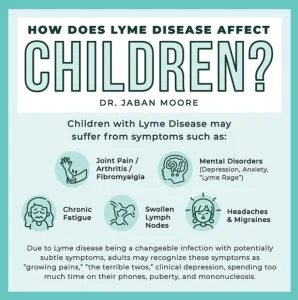
How Does Lyme Disease Affect Children?
Children with Lyme Disease may suffer from symptoms such as:
A 2014 study stated that "the reported incidence is highest in children aged 5 to 10 years, nearly twice as high as the incidence among adults."
Mental Health and Pediatric Lyme Disease:
Early symptoms of Lyme Disease are often diagnosed based on physical symptoms. However, Lyme may be involved in psychiatric and cognitive symptoms that can be easily misdiagnosed or confused with ADHD, juvenile rheumatoid arthritis, gastritis, or learning disabilities.
Pediatric Lyme Disease may also be involved in an immune dysfunction and condition known as PANS (Pediatric Acute On-Set Neuropsychiatric Syndrome). PANS can be caused by a variety of infections such as the Epstein-Barr virus, Chicken Pox, Influenza A, Lyme Disease, Lyme Co-infections, Mycoplasma Pneumoniae, and other toxicities such as mold, chemicals, and/or heavy metals.
How Do We Treat Lyme Disease in Children?
Working with a skilled practitioner is crucial when healing from these complex issues. Our clinic uses a comprehensive approach to address Lyme Disease in children, including opening drainage pathways, addressing parasitic infections, mold toxicities, heavy metals, and other infections, and supporting the body with proper nutrition and supplementation.